
Split training
- Kinga Brot
- Feb 5, 2020
- 3 min read
1. What does it mean?
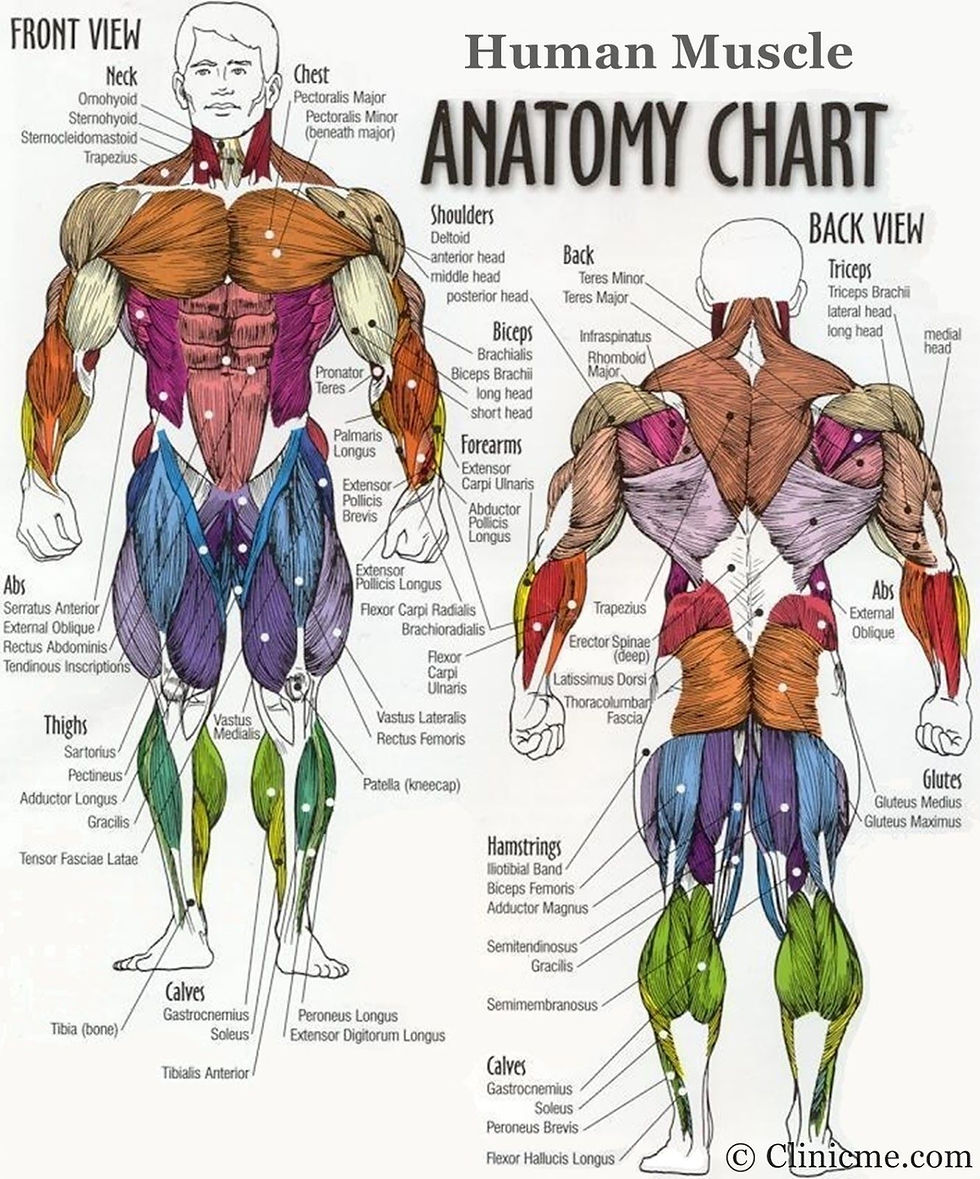
It basically means dividing weekly workouts based on the specific muscle groups worked. You can do it at the gym but you can do it at home too. 2. What are major muscle groups? Legs, chest, upper and lower back, shoulders, arms (bicep, triceps, forearms), buttocks, abdomen… Knowing your anatomy is key before you start working out. It helps you to connect your mind to the muscle and improve your performance. Take a look on the picture above and check out your muscle groups in the mirror 😉 3. Why people split workouts? Usually in order to build a specific physique because it allows you to prioritize body parts that you want to develop the most by training them more often. Split training is not only a scheduling hack but a scientifically proven method to develop muscles. Split training calls for using one (or two) muscle groups at a time in an effort to fatigue those specific muscles. Mcleister et al. (2003) suggest that muscles need 72h of rest between workouts to repair and then grow. Split training allows in this way for more trainings and it is also useful in case you are injured. 4. Full body workouts Split system training is primarily used by bodybuilders or fitness trainers; however, some professional powerlifters or lifters do not use it. If you do not have a lot of time to spend at gym or you are totally new to fitness, maybe you should not either. The American Council on Exercise (ACE) recommends full-body workouts for beginners. Training your whole body at once will be good for you if you just want to improve your health, functional strength or overall general conditioning (Schoenfeld et al., 2015). 5. The most popular splits – if you decide to give it a try... Upper – lower body split Upper body is everything what is up from you stomach and lower body what is down #leg day. Abdominal exercises you can do whenever you want; you can exercise core every day or every 2 days.
Push/Pull Split
Pushing exercises target the chest, shoulders, and triceps. The alternate day is for pulling exercises such as curls, rows, pulldowns which target the back and biceps.
Antagonistic Muscles Split Workouts
Opposing muscle groups can be trained each day as they are split into groups for three workouts per week or four workouts per week. For example: chest and back on one day, shoulders and legs on one day and then biceps and triceps. This is a list of exercises that you can do for opposing muscle groups:
• Squats and Deadlifts
• One Leg Squats and One Leg Deadlifts
• Lunge and Step Ups
• Leg Extensions and Hamstring Rolls
• Outer Thigh Leg Lifts and Inner Thigh Squeezes
• Chest Presses and Dumbbell Rows
• Front Raises and Rear Delt Flies
• Biceps Curls and Triceps Extensions
Advanced Splits
These workouts focus on just one major muscle group per day. This is what I currently do. I exercise 5 days: legs, arms, back and core, chest, shoulders and traps. I also incorporate cardio exercises (stair master, treadmill) on 4 days after these trainings. I switch my rest days depending on how I feel. I do not force myself to train legs always on Mondays if I do not feel like it, The most important is to listen to your body.
References
Mclester, J. R., Bishop, P. A., Smith, J. E., Wyers, L., Dale, B., Kozusko, J., . . . Lomax, R. (2003). A Series of Studies---A Practical Protocol for Testing Muscular Endurance Recovery. Journal of Strength and Conditioning Research, 17(2), 259-273.
Schoenfeld, B. J., Ratamess, N. A., Peterson, M. D., Contreras, B., & Tiryaki-Sonmez, G. (2015). Influence of Resistance Training Frequency on Muscular Adaptations in Well-Trained Men. Journal of Strength and Conditioning Research, 29(7), 1821-1829.


Comments